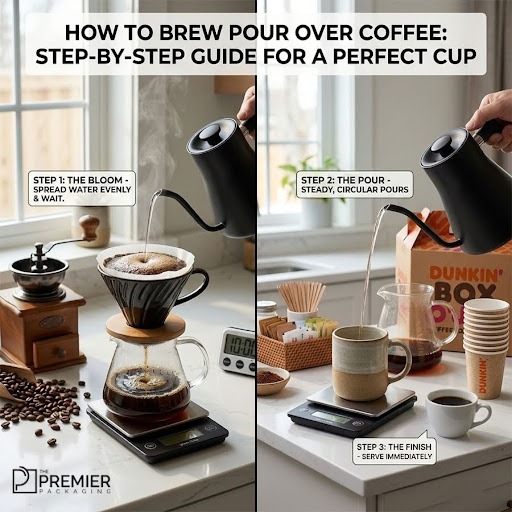
Hand-brewed coffee is a clearer, more flavorful brew than machine-brewed coffee. The secret to a more pleasant cup of coffee that showcases your coffee’s natural sweetness and complexity is simple: use fresh beans, hot water, and a few minutes. This step-by-step pour over guide will help you learn how to do it.
What You Need Before You Start
Here are the things you will need before you start brewing!
- Medium-fine ground coffee beans
- Make sure you have a gooseneck kettle
- Use brewer (Chemex, Hario V60 or other)
- Paper filter (depending on the size of your brewer)
- Digital scale (for accurate measurements)
- Timer (phone works fine)
- Coffee pot or cup to put brewed coffee in
- Fresh water (filtered, if possible)
- Quality is important: For best flavor, use beans roasted within the last 2–3 weeks.
Step 1: Heat Water to the Right Temperature
The condition of the water source is important. Bring water to a boil (200°F). If you have a digitally controlled electric kettle, set it to 200°F. When using older kettles, heat to a boil, and allow the water to cool for 30 seconds.
About 420 grams (420ml) of water is used for a typical 2 cup brew. Instead, heat carafe and mug with a few hot water molecules, then pour out before brewing.
Place the ground coffee into the grinder and repeat steps 1 and 2 until you reach the desired consistency.
- Precision ruins pour over coffee. Best results are obtained by weighing your coffee:
- 30 grams of blends (multi-origin coffee)
- 22 grams of single-origin coffee
Grind beans to medium-fine (like sea salt) consistency. Too coarse = under-extracted, sour coffee. Too fine over extracted, and bitter coffee.
Pour ground coffee into the filter, and shake the dripper over the coffee to level the grounds. This will help to avoid uneven flow while brewing.
Step 3: Prepare the Filter and Brew the Coffee
Mount paper filter into the brewer and rinse the filter with hot water. This removes any papery taste and warms your brewer. Drain rinse water. Place ground coffee, and set your scale to zero and begin your timer.
Pour 60 grams of water (3x the amount of coffee) evenly over the grounds to bloom the coffee at 0:00. Begin from the center and then move outwards in circles in a spiral manner so that all grounds are covered. The coffee will puff and bubble, which means that carbon dioxide is escaping from the roasting.
- Wait 45 s for the bloom to settle. This vents gases and sets up the coffee for even extraction.
- Pouring is finished when the second pour is complete (Step 4) (40 Seconds).
- After 40 seconds on your timer, start the second pour. Add water so that the scale reads 150 grams (total mass, including bloom water). This should only take around 10 seconds.
Start in the middle and work outwards in 5 rings then back inwards again. Place your kettle’s spout 8-10 inches above the grounds at a consistent level. Do not pour directly on the paper filter – this creates an uneven extraction.
Step 4: The Third Pour (1:10)
After 1 minute and 10 seconds, begin the third pouring. Fill until this reaches a total of 250g. Once again, count to 10 in your head.
Continue the pouring pattern: 5 laps out from the center and 5 laps back in. Maintain the height and rate of flow.
Step 5: The Fourth Pour (1:40)
Add the last water, at 1 minute 40 seconds, until the total reading on the scale is 350 grams (single-origin) or 420 grams (blends). This will be your final pour.
Continue the same concentric pattern of pouring. When poured, gently swirl the brewer to smooth and even the coffee bed for a more even pour.
Let all the water to flow through the grounds. The total brew time should be between 2:45–3:30 minutes. If it’s quicker, your grind is too coarse. If slower, then your grind is too fine. Stuff your preferred mug and savor your ideal-pour pour over coffee. No cream or sugar is added to the coffee, as this enhances its natural taste.
Why Pour Over Coffee Tastes Better?
The benefits that automatic brewers cannot compete with are the benefits of pour over brewing:
- Running water at a controlled temperature allows for proper extraction.
- Even saturation of all coffee grounds
- No over-heating, which destroys the coffee flavor.
- Adjustable ratios to suit your preference.
- Cleaner cup with paper filters that remove oils and sediment.
This produces a more nuanced, brighter, and better tasting coffee that brings out the beans’ unique origin.
Common Mistake
- Too fast or slow brew time: September 29th may be a good way to adjust grind size.
- To avoid the bloom: Leads to uneven extraction
- Pouring too quickly: Will cause channeling and make the coffee weak.
- Using fresh beans: Fresh coffee
- Hard Water: Lowlights will be enhanced by ignoring the water quality.
Pour Over vs. Box O’ Joe: When to Choose Each
Pour over coffee is ideal for brewing 1–2 cups with maximum control over the amount of coffee you’re producing. But what about if you have a good amount of people over or need a cup of coffee for a meeting? On larger occasions, many Americans opt for a convenient how much is dunkin donuts box of coffee, which offers 10 servings of decent coffee, without the hours dedicated to pouring through multiple cups.
Learn to master it in just one week
Practice makes perfect. For one week, experiment with coffee for the day using a pour over play with grind size and speed to get the perfect cup of coffee. At the end of the week, you’ll be making home-brewed, café-worthy coffee every day. Brewing coffee with a pour over is enjoyable, easy and results in a better-tasting cup. So pick up your kettle, your fresh beans and prepare your perfect cup of Coffee today!
Visit classicstylemag for more informative blogs.