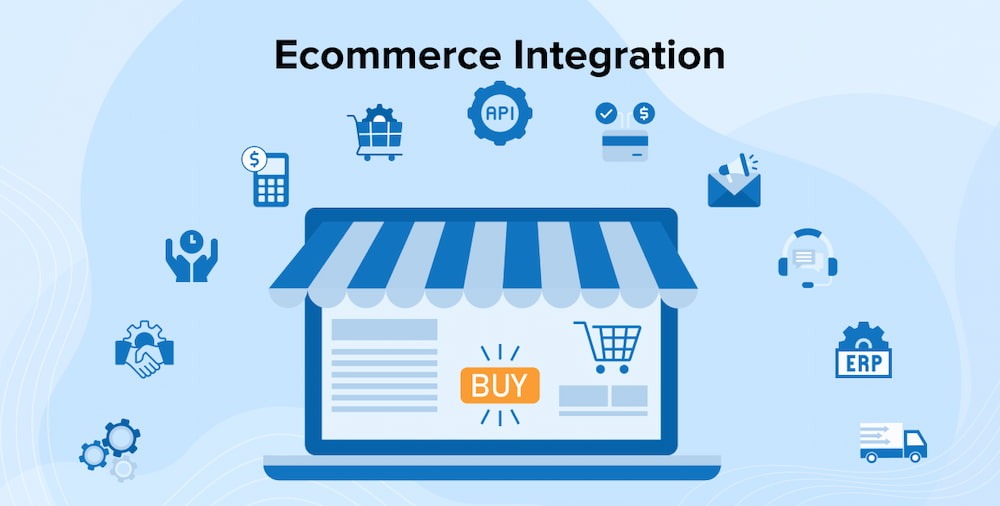
I’ve been involved in enough B2B digital transformation projects to notice a pattern.
Most companies don’t wake up one morning and decide, “We need ERP integration.” What happens instead is slower. Orders increase. Pricing gets more complex. Customer expectations shift. Internal teams start spending more time fixing data than moving the business forward.
At first, it feels manageable. Then it doesn’t.
That’s usually the tipping point for B2B eCommerce ERP integration.
It’s Not About Connecting Systems. It’s About Removing Friction.
On paper, integration sounds technical. Connect your eCommerce platform to your ERP so inventory, pricing, and orders sync automatically.
In reality, it’s operational.
Your ERP is where the business logic lives — inventory rules, customer contracts, tax configurations, credit limits, fulfillment workflows. Your eCommerce platform is customer-facing. It needs to be fast, intuitive, and accurate.
When those two systems operate in isolation, teams compensate manually. Sales checks pricing before approving orders. Operations double-checks stock. Finance spends extra hours reconciling mismatches.
From my experience, that manual “bridge” works until order volume grows by 20–30%. After that, cracks show up quickly.
Where Most Teams Start Feeling the Pain
The common scenario looks something like this:
- Website captures the order
- Someone exports data
- ERP gets updated manually
- Inventory is validated
- Pricing adjustments are applied
It’s not elegant, but it functions — at low scale.
The real pressure begins when:
- Contract pricing varies per customer
- Multiple warehouses are involved
- Customers expect real-time stock visibility
- Sales pushes self-service ordering
- Order volume spikes during peak seasons
This is where most teams struggle. Not because the systems are bad, but because the architecture wasn’t designed for growth.
People become the integration layer. And people, no matter how capable, aren’t scalable infrastructure.
Real-Time Inventory: Small Detail, Big Trust Factor
Overselling in B2B is expensive. Not just financially, but relationally.
When your ERP and eCommerce platform are properly integrated, inventory updates in near real time. What customers see online reflects what’s actually available.
That reduces awkward emails. Fewer apologies. Less back-and-forth.
It also gives operations clearer demand signals. Purchasing decisions improve. Planning gets tighter. You stop reacting and start forecasting.
Order Automation Changes the Tempo of Operations
Manual order entry might not seem like a big deal. But in high-volume environments, it’s a silent margin killer.
When orders flow automatically from the eCommerce platform into the ERP:
- Data entry errors drop
- Fulfillment starts faster
- Order confirmations are instant
- Backorders trigger correctly
In one mid-market project I worked on, removing manual order entry reduced processing time by almost 40%. No dramatic overhaul. Just cleaner integration.
Sometimes efficiency gains are hiding in plain sight.
Pricing Logic Belongs in One Place
B2B pricing isn’t simple. It’s layered. Negotiated contracts. Tiered discounts. Volume-based incentives. Sometimes even geography-specific rules.
Without integration, pricing logic often gets duplicated — once in the ERP and again in the eCommerce platform. That’s risky.
I’ve seen teams spend weeks chasing margin discrepancies caused by minor mismatches between systems.
When ERP integration is designed correctly, pricing authority stays inside the ERP. The website reflects it dynamically.
Sales stops fixing orders after the fact. Finance stops second-guessing reports. Everyone works off the same numbers.
That alignment matters more than people expect.
What the Architecture Usually Looks Like
Most B2B eCommerce ERP integration projects follow a fairly straightforward flow:
eCommerce Platform → Integration Layer → ERP
The integration layer isn’t optional. It’s what handles:
- Data transformation
- Validation logic
- Error handling
- Scheduling or event-based triggers
Modern setups lean heavily on APIs and event-driven updates. Batch jobs still have their place — especially for large catalog updates — but real-time synchronization is becoming the norm in competitive B2B markets.
And yes, architecture decisions made early will either make future scaling smooth… or painful.
Choosing the Right Integration Approach
There isn’t a universal blueprint. It depends on your systems and complexity.
API-based integration works well when both platforms expose strong APIs. Clean, direct, scalable.
Middleware solutions are useful when you’re connecting multiple systems — ERP, CRM, warehouse management, logistics providers. It prevents tight coupling.
iPaaS platforms can speed up deployment, especially for cloud-native stacks. But they still require thoughtful design.
And sometimes, custom integration is unavoidable. Particularly with legacy ERPs that have been heavily modified over the years.
From experience, shortcuts in integration almost always resurface later as operational headaches.
Common ERP and eCommerce Platforms in B2B Projects
In many mid-size and enterprise environments, ERP integration often involves platforms like:
- SAP S/4HANA
- Oracle NetSuite
- Microsoft Dynamics 365
- Epicor
- Infor
- Sage
On the commerce side, common platforms include:
- Adobe Commerce
- Shopify Plus
- BigCommerce
- Salesforce Commerce Cloud
- OroCommerce
In practice, the ERP brand matters less than how it’s been customized internally. That’s usually where complexity lives.
Implementation: Where Reality Meets Planning
Most successful integrations follow a rhythm, even if the timeline shifts.
Discovery comes first. And honestly, it’s often underestimated. You need clarity around data ownership, warehouse logic, pricing exceptions, tax rules, fulfillment flows.
Then architecture design. Define how data moves, how errors are handled, how security is enforced.
Data mapping takes longer than expected. It almost always does. Product structures, customer records, legacy fields — rarely clean.
Development and testing follow. Stress testing is critical. Low-volume tests won’t expose concurrency issues or API bottlenecks.
Launch isn’t the finish line. Monitoring is. Dashboards and automated alerts should be live from day one.
For mid-sized businesses, 8 to 16 weeks is realistic. Enterprise environments can stretch beyond that, especially when global operations are involved.
Cost: The Honest Answer
There’s no fixed number. But broadly speaking in the U.S. market:
- Basic integration: $15,000 – $40,000
- Mid-level customization: $40,000 – $100,000
- Enterprise-scale projects: $100,000 – $250,000+
The real drivers are ERP customization depth, number of integrations, real-time requirements, and compliance standards.
What’s often overlooked is the cost of not integrating properly. Manual labor. Order errors. Customer churn. Margin leakage. Those add up quietly.
Where Projects Usually Go Wrong
In my experience, failures rarely come from bad code. They come from unclear ownership and rushed architectural decisions.
Common issues include:
- Data mismatches from inconsistent master records
- ERP slowdowns due to aggressive API polling
- Duplicated pricing logic
- Lack of monitoring for integration failures
And here’s the uncomfortable truth: most of these problems are preventable with better planning.
Security Has to Be Designed, Not Added Later
ERP integration touches financial data, customer information, and operational records.
Token-based authentication. Encrypted data transfers. Role-based access control. Audit logs.
These shouldn’t be afterthoughts. They should be part of the initial architecture conversation.
What’s Changing in B2B ERP Integration
The direction is clear.
More event-driven architectures.
More headless commerce setups.
More automation layered on top of integrated systems.
AI-based demand forecasting and predictive inventory management only work well when the underlying data flows are clean.
Integration is becoming less about connectivity and more about creating a reliable data backbone for future automation.
And in competitive B2B markets, that backbone isn’t optional anymore.
It’s expected.
FAQs
What is B2B eCommerce ERP integration?
It connects your online store with your ERP so inventory, pricing, orders, and financial data sync automatically and accurately.
How long does integration usually take?
For mid-sized organizations, 8–16 weeks is common. Complex enterprise projects take longer.
Is real-time integration necessary?
For inventory, pricing, and order processing — yes. Batch processing still works for bulk updates, but real-time improves accuracy and customer experience.
What’s the biggest risk in ERP integration projects?
Unclear data ownership and poor architectural planning. Those cause most long-term issues.
Is it worth the investment?
When done right, integration reduces manual work, improves operational speed, and strengthens customer trust. Over time, the return is usually visible — not just in cost savings, but in smoother operations overall.